Category : Financial

Income from Belgium? Don't forget the declaration in the Tax NON-INVIRONERS
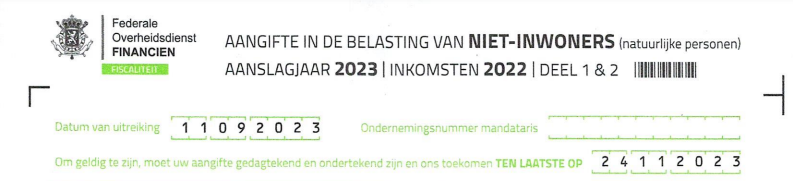
The "Non-Resident Income Tax" (GNI) refers to the tax levied on the income of non-residents of Belgium who generate income in Belgium. In other words, it is the return for individuals who do not have a tax residence in Belgium, but do (or do not) receive taxable income from Belgian sources.

The specific rules and rates may vary depending on the type of income (for example: income from real estate located in Belgium, income from employment in Belgium, pensions, benefits, etc.). Certain exemptions or reductions may also apply, depending on bilateral tax treaties between Belgium and other countries. In short, every euro that leaves Belgium and is sent to your bank account must be declared, and that applies to ANYONE.

Keep in mind that the last day to file this return is 24/11 of the current calendar year. Failure to complete it may result in penalties and even the deletion of income.

If you have specific questions about the GNI non-resident tax in Belgium, such as rates, deductions, or how to declare this tax, I recommend that you contact a Belgian tax advisor or the Belgian tax authorities for the most up-to-date information: email to tax.belgium@minfin.fed.be or call 0032 2 572 57 57.

BNI - Tax for Belgian non-residents in Belgium but still receiving income from Belgium

GNI, or "Non-Resident Tax," in Belgium is a tax levied on the income of non-residents who receive certain income from Belgium. Unlike residential taxpayers, who pay tax on their worldwide income, non-residents pay taxes only on income derived from Belgian sources unless there is an agreement with the country of residence to avoid the double taxation waiver treaty.

There are several categories of income that may be subject to this tax, including income from employment performed in Belgium, rental income from Belgian real estate, income from a Belgian company, pensions, benefits, profits of all kinds, allowances, ...

GNI rates and rules can vary depending on the type of income and the specific circumstances of the non-resident. In addition, double tax treaties that Belgium has with other countries may affect how and where the tax is levied.

If you have specific questions about your situation or need more detailed information about BNI, it is advisable to contact a Belgian tax advisor or the Belgian tax authorities. You can find out if you need to file a tax return through the WWW.MYMINFIN.BE web portal.

For Dutch, French or customers with a nationality other than Belgian, please contact the tax authorities of your previous country of residence or the country where you were previously employed.

IBI-SUMA CADASTRE TAX 2023

Every owner of a property in Spain (a house, garage, shed, plot of land,...) must pay the annual property tax, better known in Spanish as the Impuesto sobre Bienes Inmuebles (IBI). Per separate cadastre number (this is the registration number of your property), a percentage of property tax will be levied annually. The IBI applies to anyone who owns a home or other type of property in Spain.

The amount of the IBI is set by the municipality of the place where the property is located and is calculated on the cadastral value (valor catastral) of the property. If you have a home in Madrid but also a country house on the coast, both properties will be subject to a property tax, which may differ in assessment rate. The amount of the tax is subject to change.

It is not unusual for sometimes significant increases in the valor catastral to occur as municipalities strive to bring the valor catastral closer to the real market value of the property. More and more municipalities are revising cadastral values.

Most municipalities usually send out this annual tax assessment between June and October , showing the amount payable and the cadastral value along with the property number. It is best to check with your own municipality when the payment is due. This assessment can be paid in person at the municipality (especially the first time) after which one can order that this can be automatically withdrawn from the bank account in the future. Those who have an automatic order drawn up will be notified annually in advance (nowadays by email) about the tax to be paid, from which account it will come and when it will be withdrawn.

It happens in many municipalities that at the same time as the IBI assessment they also send an assessment for paying the tax for garbage collection (recogida de basuras). In addition, owners of parking lots may receive a separate assessment for the cadastral value of that parking lot or you may receive a separate assessment for having plants in your yard.

So you no longer need an intermediary to pay this tax. Many law firms or gestors charge you extra to keep this in order for you annually while this can be paid automatically. Through the IBAN, your international account number for payments across borders, you can perfectly have these taxes paid automatically every year through your bank account in your country of residence.

Personal income tax return 2022

The annual returns Model 100 and Model 714

If you live in Spain, you have undoubtedly heard of model 100 and / or model 714. Both models are important for residents of Spain and concern the declaration of your world income and world wealth. Between 6 April and 30 June at the latest, you can declare these incomes and assets.

The modelo 100

Model 100. Impuesto sobre la Renta de las Personas Físicas. Declaración anual.

Once Spain has become your permanent residence you will fall under the category of Spanish resident, Spanish tax resident. This means that you have fiscal obligations in Spain - Spain considers you as fiscal resident when you stay more than 183 + 1 days in Spain (this can be consecutive or with intervals). Please note that as a fiscal resident there are differences in obligations, it can be that you only have to make a declaration of your income or it can be that you also have to pay taxes. This depends on various factors.

When you are considered as tax resident in Spain you will have to declare your worldwide income to the Spanish tax authorities between the beginning of April of the current calendar year and the end of June of the current calendar year (June 30th is the last day). Someone who stays more than 183 +1 days per year in Spain, even when he has not yet applied for a residency, will be seen by the Spanish tax authorities as tax resident!

In Spain, the income tax is progressive (i.e. the tax rate increases per bracket in relation to the amount of income received). For the income of the previous calendar year = fiscal year, the applicable rates are between 19% - 45% since 2020. As a Spanish resident, you can deduct up to a certain amount of mortgage costs (interest and repayments of the first and only home in Spain) from your taxable income.

Below is the table of the income bands and the tax due per band in relation to the percentage taken by the tax authorities. There are still exemptions applicable and age and family situation also determine what you ultimately owe. For 2022 there are no changes in the percentages compared to the previous year.

Important note: If, for example, you receive an income (pension, interest, dividends, returns,...) which is taxed at source, then you will not pay taxes in Spain on this income unless there is an agreement between Spain and that country to avoid double taxation.

Important note on the number 22,000 and the exemption!

What does this have to do with who has to file a tax return for residents in Spain? This is one of those areas where figures have only added to the confusion. The issue of who should file a tax return for residents has been rather confused over the years by the publication of the amount, €22,000 as the threshold.

Some people have the idea that if your income is lower, you do not have to file a tax return. Various publications from news sources report only half the reality of this issue or their explanations are incomplete. Every year, this causes confusion and endless discussions. Here, we will make it clear to you once and for all.

You are only exempt from paying €22,000 if you are employed by only one employer and already pay Spanish withholding tax as you earn. A situation that applies to very few expats.

So, submitting your tax return correctly avoids that you can be fined for not declaring or declaring incorrectly, but a tax return also has benefits. Presenting annual tax returns makes obtaining a tax residency certificate - El certificado de Residencia Fiscal - much easier. The tax residency certificate is what is needed in the case of claiming residency for inheritance purposes. You will also need one to ensure that there is no 3% retention if you sell your Spanish property as a Spanish tax payer.

The modelo 714

Modelo 714. Impuesto sobre el Patrimonio. Declaración y documento de ingreso

You are obliged to file a wealth tax return in Spain on your own initiative, annually before 30 June, if your assets exceed the exemptions in Spain.

If your gross assets (your assets without deduction of debts) are more than EUR 2 million, you must always file a tax return, even if your net assets (after deduction of debts) fall under the exemptions.

Residents have to declare their assets in Spain and in other countries. Non-residents only have to declare their assets in Spain. The tax that has to be paid in Spain can usually be settled in the home country.

Residents and non-residents only have to pay wealth tax if they have assets above 700,000 Euro s with an exemption for their own (main) home (vivienda habitual) 300,000 Euro s (does not apply to non-residents as they do not have a main home in Spain).

What can Segurantis do for you?

Segurantis can take care of your personal tax for both residents and non-residents in Spain. Feel free to contact us to discuss your situation.

Energy certificate for rental

Holiday rentals must now have an energy label since 2021

Since 1 June 2021, it is mandatory to have an energy label for holiday homes in addition to a rental licence. If you do not comply with this and an inspection follows, the fines can be high.

Like many other countries, Spain has the energy label for dwellings, or the 'certificado energético'. The energy label gives an indication of how energy efficient a house is. If you sell or rent a property, you must have a valid registered energy label.

According to the Spanish Statistical Office (INE), there are almost 300,000 holiday homes for rent (officially registered) in Spain. Owners of these tourist properties are obliged to mention the energy label when renting out the property (promotion and advertising included). The energy label must also be stated in the rental contract.

The regional authorities of the 17 autonomous regions are responsible for ensuring compliance with this law. In the event of inspection and non-compliance, fines can be between EUR 300 and EUR 6 000. The fines can range from light to serious. More information can be found under.

The fines are applied immediately. This applies to the owners of the property but also to the platforms, landlords, intermediaries where a property is offered for rent.

Sources:

Government Gazette BOE-A-2021-9176

https://www.idealista.com/news/vacacional/mercado-vacacional/2021/06/28/791130-atencion-propietarios-el-certificado-energetico-ya-es-obligatorio-para?xts=582065&xtor=RSS-86

https://www.idealista.com/news/vacacional/mercado-vacacional/2021/06/28/791130-atencion-propietarios-el-certificado-energetico-ya-es-obligatorio-para?xts=582065&xtor=RSS-86

What can Segurantis do for you?

Go to the overview of our services.

Crypto currencies and taxation in Spain

The Spanish taxman gets his money's worth

Those who have invested in crypto currencies will probably have had a good 2020. The prices rose sharply in 2020 and 2021 is also a year where the prices remain fairly stable after what was a turbulent spring.

Anyone who has cashed in the profits will have to take account of them in their personal tax return. The Spanish tax authorities consider the profits as a form of investment return (similar to the profits, dividends, interest, etc. from investments such as shares, investment funds, derivatives, etc.).

If the profits have not been realised, i.e. you have not sold your crypto coins, they do not fall under returns achieved and you are exempt from the declaration. If the total value of your crypto portfolio is above the exemption limit of the wealth declaration, then you are obliged to file the wealth declaration and to report the total value that has been invested.

What can Segurantis do for you?

Go to the overview of our services.

Spanish wealth tax

People photo created by bearfotos - www.freepik.com

Spanish wealth tax is applicable to residents

If you are a permanent resident in Spain and have assets of at least EUR 500,000, it is best to check whether you are eligible for the wealth tax

There is an exemption limit and it can differ per autonomous community. Generally, the exemption limit is 700,000 euros, from which you may deduct your own home up to a maximum of 300,000 euros. But in some communities, such as Catalonia, the exemption limit is 500,000 euros. There are 17 federal states in Spain so keep this in mind.

In order to determine that you have to file a tax return on your assets, you will have to attach a value to your assets, which is determined annually on 31/12/.... of the calendar year. So, for example, you will have to determine a value for investments (shares, funds, ...), but also other forms of investments including crypto coins. It is your responsibility to reflect that value correctly.

If the sum of your investments, real estate (minus own home) exceeds the exemption limit, you will have to submit a wealth tax return.

What can Segurantis do for you?

Go to the overview of our services.

Spanish personal income tax and payments

Payment periods and what if the payment is not made

The Spanish personal income tax declaration period is over. The last day to submit the declaration within the legal deadline fell on 30 June of this calendar year. This concerns the personal income tax of both residents and Spaniards. The declaration is about the income obtained in the previous calendar year.

You have not made a declaration? You can still make a declaration, but this is of course outside the normal legal term. In Spanish, this is called Fuera de plazo. Fines and negligence interest can be applied. Simply not declaring is better avoided. Even if you don't have to pay taxes in Spain (origin of income or below the threshold) as a resident (not Spanish) you should still make a declaration (*the reasons for this are very diverse).

I have to pay taxes but nothing has gone out of my account yet? If you did not have enough money in your account the payment will not go through. You will then have to apply for an NRC through your bank or through the Certificado digital through your fiscal representative for the Carta de pago from the moment you are recognised within Hacienda as a "non" payer (this can sometimes take several weeks).

You are paying in instalments? Then you will first receive from Hacienda an answer of approval (or refusal) to grant you this right. This form states how many times the payment will be withdrawn from your account and the corresponding interest. It can sometimes take a while before you are notified of this.

Tip: Do not go on your own initiative to pay your taxes if you think a mistake has been made. First seek advice from your tax representative or a local Hacienda office.

What can Segurantis do for you?

Every year we help many residents to fill in their Spanish declaration. It is important to know that when you stay more than 183+1 days in Spain you will be considered by the Spanish tax authorities as tax resident with all the fiscal consequences that come with it. When you are tax resident in Spain but you receive income from outside of Spain you might have to fulfil tax obligations in these countries on a yearly basis.

Closure of the Spanish personal income tax file

Do not forget your Spanish tax obligations as a resident

We inform you that the files for the submission of the annual Spanish Personal Income Tax are closed. Customers who have not yet received the result of the calculation will receive it soon as the last files are being finalised.

Towards next year we will no longer accept files from outside the communidad Valencia and Murcia. These persons better look forward to a local office for their tax obligations.

Remember that if you receive income from a country other than Spain, you will probably still have obligations to that country. Consult the tax authorities of that country on what to do.

What can Segurantis do for you?

Go to the overview of our services.

IPS: Taxation of insurance

From 6% to 8%

In 2021 the Spanish government has decided to increase the tax they charge on every insurance policy taken out from the 6% to the 8%. This is something that does not happen quickly and in recent years the government has not increased it. But it is not surprising.

The Corona crisis damaged the Spanish economy last year, but will continue to do so for some time. Spain is one of the countries that has been hardest hit by this crisis in Europe. The government has distributed several aid packages last year and these financial concessions now have to come back from somewhere. The insurance sector is one of these sectors that will be taxed extra.

The increase is therefore a tax that has nothing to do with your premium . This additional cost is exclusively for the government and is beyond the companies' control. An annual adjustment of consumer prices is a fixed fact which causes products, including insurances, to increase slightly each year (consumer price index). But an extra 2% of taxes is obviously felt.

We hope the government will stick to this one-time increase and not raise taxes on all prices of services and products every year. Everything will depend on how the economy will recover.

At Segurantis we always try to correctly reflect our services price quality. We try to find out for our clients every year how we can offer them the best price guarantees with the highest service.

What can Segurantis do for you?

Go to the overview of our services.